
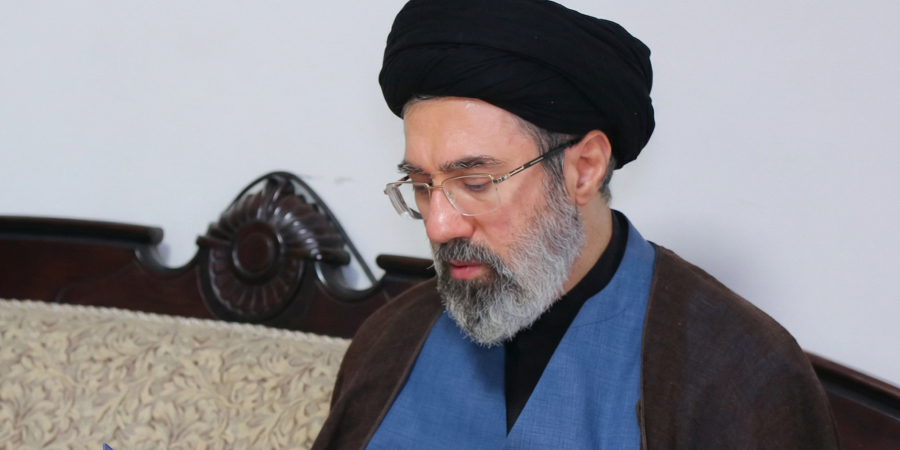
His beginning
His Eminence Ayatollah Sayyid Mojtaba Hosseini Khamenei, the esteemed Leader of the Islamic Revolution (may God’s blessings be upon him) and the second son of the martyred, mujahid Leader of the Revolution, Grand Ayatollah Sayyid Ali Khamenei (may God be pleased with him), was born in 1348 AHS (1969 AD) in the holy city of Mashhad. His childhood was spent in Mashhad until the year 1357 AHS (1978).
Presence in the Sacred Defense
He completed his primary and secondary education in Mashhad and Tehran, respectively. While he was still a student at the age of 16, he went to the fronts of the Sacred Defense and served in the Habib ibn Mazahir Battalion of the 27th Rasul Allah Division. He was also active in the Sayyid al-Shuhada Division for a period. He participated on the frontline in some operations, including in Operation Karbala1.
Brigadier General Ali Fazli, one of the veteran commanders of the Sacred Defense, described Sayyid Mojtaba Hosseini Khamenei insistence on remaining anonymous among his fellow soldiers as follows:
“It was a blessing that we had the honor of being in the presence of my highly esteemed brother, Ayatollah Sayyid Mojtaba, in the Sayyid al-Shuhada Division for a period of time. During the time he was with the division, he advised that I address him as ‘Mr. Hosseini,’ saying he had come to fulfill his duty and responsibility, not for name, title, or self-glorification.
Ayatollah Mojtaba had also served in the 10th Division. During the period he was with the Sayyid al-Shuhada Division, we witnessed many remarkable qualities in him. His expectations were equal to - or even less than - those of the other soldiers. I never saw him ask for anything more than what the other soldiers had, or even hint at such a desire. Rather, he was content with having less.
He always sought to be present in the places where the danger was greater, and he avoided staying in designated safe areas. Regularly visiting and checking on the front lines was one of his constant principles and priorities. At appropriate times, he would also joke and speak warmly with the young soldiers.
He had a special behavior when it came to prayer. Whenever congregational prayers weren’t being held, he would try to perform his prayers in secluded, dimly lit places where fewer people were present. We had many tents there, but for prayer and talking with God in private, he would choose the most remote, isolated areas. This wasn’t something that he did just once or twice. It was a recurring practice throughout the time he was with the division.”
Likewise, Martyred Brigadier General NurAli Shoushtari, one of the distinguished commanders of the Sacred Defense, spoke of his presence during one of the operations:
“Sayyid Mojtaba seemed troubled, so I asked him, ‘What’s wrong?’ He pointed to his glasses and said, ‘They’re broken!’
I said, ‘That’s nothing to be upset about.’
He replied, ‘But this means I’ll fall behind from the operation, and I’ll have to keep dealing with this instead.’
This operation was highly complex, and there was a possibility that some of the forces may be taken captive. Therefore, those who were participating were among the most advanced and most courageous.
I had told my friends in private to not repair Sayyid Mojtaba’s glasses, hoping the others would start out while he and those with him would remain behind. But while I was busy with radio communications and other responsibilities, he had taken his glasses, temporarily repaired them with a pin, and already set off toward the front.
No matter what I did, I couldn’t stop them and they had gone.
I then contacted their division commander and told him, ‘They’re on their way. Be careful that they don’t take part in the line-breaking operation.’
When I went to the area the next day, I saw that they had positioned themselves on the heights of Qashan at the front of the defensive line in a place where evacuating the wounded was truly difficult and delivering ammunitions and supplies was extremely challenging.
I spoke with our brother Fazli and said, ‘Mr. Fazli, these two have gone to a very dangerous place. Their martyrdom is one matter, but if they’re taken captive, it will have a very large propaganda cost for us.’
He replied, ‘I told them this last night, but they themselves went voluntarily.’”
Seminary education to the level of ijtihad
Ayatollah Sayyid Mojtaba Khamenei began his seminary studies in 1985 in the seminaries of Tehran, and in 1989 he transferred to the seminaries in Qom. He completed advanced levels in the seminary under the supervision of prominent scholars such as Ayatollah Ahmad Mianji, Reza Ostadi, Owsati, and several other distinguished teachers. From 1992 onward, he attended Higher Islamic Studies (Kharij) classes in the area of jihad under the martyred mujahid Imam, Grand Ayatollah Imam Khamenei (may his soul be sanctified), as well as the advanced jurisprudence and Islamic principles classes of Ayatollah Sheikh Mojtaba Tehrani, who was one of the long-standing students of Imam Khomeini (may his noble soul be sanctified). During this period, he also pursued studies in certain other academic fields, as well as an advanced English language program.
In 1997, Ayatollah Sayyid Mojtaba Khamenei married Zahra Haddad Adel, who was martyred beside the martyred Leader this year. In that same year, he once again migrated to Qom in order to complete his seminary education and benefit from that spiritual environment. He attended the advanced jurisprudence and Islamic principles classes of Ayatollahs Wahid Khorasani, Sheikh Javad Tabrizi, Sayyid Musa Shubairi Zanjani, and Sheikh Mohammad Mo’men Qomi for a period of 17 years. His submission of scholarly notes (taqrirat) on Arabic lessons, along with his continued engagement in critical analysis and scholarly questioning outside the classroom, attracted the special attention of several senior teachers.
His talent, diligence, and sustained intellectual perseverance combined with his scientific exactitude and independent scholarly thinking led to numerous well-grounded innovations in the seminary sciences, particularly in jurisprudence and Islamic principles (fiqh va usul) along with in biographical studies (rijal). His possession of a systematic, coherent, intellectual foundation in Islamic knowledge, along with his commitment to that framework in his scholarly output in various subjects, is considered to be one of his key distinctions. His mastery of the jurisprudential – Islamic principles schools of thought of Shaykh al-Ansari, Akhund Khorasani, Muhaqqiq Naini, Agha Zia Iraqi, Muhaqqiq Isfahani, Imam Khomeini (may Allah sanctify his soul), as well as Ayatollahs Boroujerdi, Khoei, and Shahid Sadr (may God’s mercy be upon them), has contributed to the strength and richness of his intellectual foundation.
His careful attention to the works of the companions of the Infallible Imams (peace be upon them), to the views of early scholars, and especially to the concept of “jurists’ common knowledge (irtikaz al-mutasharri‘a)” during the time of the Infallible Imams” and its fundamental role in the process of legal deduction (istinbat) is of significant importance.
One of the important dimensions of Ayatollah Sayyid Mojtaba Khamenei’s personality has been his close connection with major figures in ethics and mysticism, including Ayatollahs Baha’ al-Dini, Behjat, Kashmiri, Sheikh Ja‘far Mojtahedi, and a wide range of other spiritual figures.
A brief overview of his teaching and seminary activities
Alongside his studies, Ayatollah Sayyid Mojtaba Khamenei has continuously engaged in teaching jurisprudence and Islamic principles. He first began teaching introductory seminary courses in the Tehran seminary. Following the recommendation of Ayatollah Imam Sayyid Ali Khamenei about the need for reform in the seminaries and the importance of the works of Shahid Sadr, he stopped teaching Ma‘alim and started teaching the Halaqat al-Usul of Shahid Sadr instead.
After moving to Qom, he initially began teaching Rasa’il and Makasib in the honorable residence of Imam Khomeini (may his noble soul be sanctified) in Qom.
He was also busy teaching the book Halaqat and Islamic principles
He moved to teaching in the Feyziyeh Seminary in 2007. In 2008, his private Higher Islamic Studies course (Dars Kharij Fiqh) on salat was conducted in the office of Ayatollah Imam Khamenei (may God be satisfied with him) in Qom. At the request of his former students, his formal, public advanced jurisprudence course was launched in the Qom office starting from the beginning of the 2009 academic year. After one year, his advanced Islamic principles course officially began in 2010. It started with study of the first topics in Islamic principles and continued up to the section on istishab (where an existing situation is presumed to be unchanged unless there’s proof of change).
Prior to teaching, he would write and systematize the structure of his scholarly discussions. And after teaching too, he has written his jurisprudential – Islamic principles discussions himself in his own handwriting, and some volumes of this are ready for publication.
His scholarly notes (taqrirat) were prepared for publication by some of his students some time ago. But due to his reluctance, they haven’t yet been published publicly and have only been made available to a select group of seminary scholars and specialists because of some of their repeated requests.
In keeping with the tradition of earlier scholars, he would devote time between jurisprudence and Islamic principles classes to friendly, informal discussions to help students gain a deeper understanding of some of the finer points of the lessons, and he would answer their academic questions and objections. In addition, at the beginning of his jurisprudence lessons he would allocate a short time to a discussion on the exegesis of the Holy Qur’an, and he would provide original, profound insights on its blessed verses. Another important aspect of his teaching was his strong emphasis on student development and his careful attention to students’ scholarly objections. After classes too, some students would ask their questions and make comments in extended in-person and remote discussions, and they would receive responses that were given with patience, attentiveness, and care.
Among the distinctive features of his teaching style and commitment were his strengthening students critical thinking ability, training them in the practice of legal deduction (istinbat), and organizing opportunities for students to give academic presentations on certain jurisprudential issues.
Innovation in both content and teaching style – such as mastery of the intellectual foundations and views of earlier scholars, critical evaluation of fundamental principles and systematic organization of topics, organized and logical exposition, intellectual openness and scholarly freedom, along with his exemplary ethics and humbleness, etc. - gradually led his advanced Islamic studies class in Qom to become one of the most crowded advanced courses in the seminary. At the beginning of the 2022 academic year, over 1,300 students registered for his course. In this situation, news of the announcement of the discontinuation of his class in the first session of the new academic year came as a surprise to all his students.
Following this, attempts were made to persuade him to change his mind. In one such attempt, 1,000 seminary students and professors in Qom submitted a letter to the martyred, mujahid Leader (may God elevate his rank) requesting the resumption of the classes. Several senior scholars in Qom also made this same request orally. But in a meeting with a number of his senior students, Ayatollah Sayyid Mojtaba Khamenei spoke of the reason for suspending the classes as being a spiritual matter that could not be disclosed. He emphasized that in the post-COVID period when many seminary courses with outstanding professors had become less active or were suspended, there was no justification for his class to continue with such large numbers. He asked those present to stop all public and private requests for the resumption of the course.
Ayatollah Sayyid Mojtaba Khamenei told his students, “Guide the students and scholars in the class toward other teachers,” and he described “scholarly competence,” “commitment to the Revolution,” and “spiritual integrity” as being some of the essential qualities of an ideal teacher.
Due to the insistence of his companions and his awareness of the recommendation of the martyred Leader of the Revolution that he undertake writing marginal annotations (hashiyeh nevisi) for Urwat al-Wuthqa, after his initial reluctance, he focused his scholarly efforts on this issue and on rewriting his jurisprudential and Islamic principles lessons.
On the other hand, his concern for strengthening the part of jurisprudence in the Qom seminaries, which is based on the reform-oriented approach envisaged by the martyred Leader of the Revolution, led Ayatollah Sayyid Mojtaba Khamenei to independently establish certain academic centers and jurisprudential schools and to support revolutionary jurisprudential institutions and centers (with different tastes and scholarly approaches). Simultaneous attention to academic matters and social concerns, particularly helping the deprived, led to the formation of a comprehensive program for this matter in these schools. As a result of this, a number of faithful, revolutionary, compassionate, people-oriented individuals have now been trained.
His exceptional caution and attention to avoiding any concentration on his own person, his emphasis on strengthening the sacred seminary and the seminary-based revolutionary current, his emphasis on the centrality of the intellectual line and unique personalities of Ayatollah Imam Khomeini (may God have mercy on him) and the martyred Ayatollah Sayyid Ali Khamenei (may God be pleased with him), his caution in preventing the formation of certain common rivalries, and other matters, has brought the admiration of many senior scholars and the strong inclination of a wide range of professors and scholars for these institutions.
A glimpse at his moral conduct in life
Ayatollah Sayyid Mojtaba Khamenei enjoyed special attention from his father, and in matters of ethics, mysticism, and piety, he always benefited from his guidance and support. In this regard, a message written by the martyred Leader at the beginning of a book gifted to his son clearly reflects this special attention:
“In the name of God, the Most Exalted. I am presenting this valuable book to the light of my eyes, my dear Mojtaba Hosseini. I pray that God, through him, will bring more benefit to Islam and the Muslims, and that God will guide him, keep his steps firm and free of error, and protect him from mistakes and slips in both word and deed. God’s humblest servant, Ali Hosseini Khamenei.”
His Eminence Ayatollah Sayyid Ali Khamenei always warned his children against becoming attached to material things. Due to this, Ayatollah Sayyid Mojtaba Khamenei has adopted a simple seminary life.
In addition, throughout the years of his studying and teaching in Qom and Tehran, he has always sought to remain completely anonymous and avoid fame.
Managerial and governmental background
In the political and social sphere as well, His Eminence Ayatollah Sayyid Mojtaba Khamenei served the martyred Leader for years, sometimes as an executor of his instructions and sometimes as a link between the leadership and authorities in politics, the military, culture, economics, etc. The children of the martyred Leader of the Revolution avoided becoming involved in conventional political party and factional activities. Nonetheless, this didn’t prevent the martyred Leader from benefiting from the political and social capabilities of his children in carrying out leadership-related affairs.
In the political sphere and in communications with military officials and political figures, the martyred Leader made use of the services and capabilities of his son, Ayatollah Sayyid Mojtaba Khamenei. Naturally, this didn’t mean his son was independently or separately involved in the affairs of the country. Rather, he effectively functioned as his father's assistant in these matters and served him. This is the reason why over the course of more than 20 years, Ayatollah Sayyid Mojtaba Khamenei became familiar with many of the political, military, and administrative affairs of the country. Furthermore, he was also a witness, companion, and trusted adviser in many details of his father’s decisions and choices.
Those familiar with the martyred Leader of the Revolution’s management style confirm that his children, while strictly avoiding interference in state affairs, were trusted assistants, reliable advisers, and supportive companions to their martyred father.
Ayatollah Sayyid Mojtaba Khamenei’s extensive familiarity with major national issues, his close engagement with many senior state officials in different periods, his conducting numerous work sessions, his wide-ranging studies in various academic fields, his continuous meetings with intellectuals, and his attainment of fundamental solutions in different areas of both micro and macro issues of governance have turned him into a valuable asset for the leadership of the Islamic Revolution.
His continuous contact with military commanders and leaders of the Resistance Front - especially the master of the martyrs of the Resistance, Martyr Sayyid Hassan Nasrallah, and the martyred commander Haj Qasem Soleimani - is another important dimension of Ayatollah Sayyid Mojtaba Khamenei’s personality.
The sum of these factors has resulted in the long-standing, deep hostility of the United States and the Zionist regime toward him and their continuous efforts to carry out a character assassination of him and the physical elimination of him, as well as their issuing various verbal and active threats aimed at preventing his selection as the Leader of the Islamic system. But all of these, by the grace of Imam Mahdi (may God hasten his reappearance), have failed so far.

