
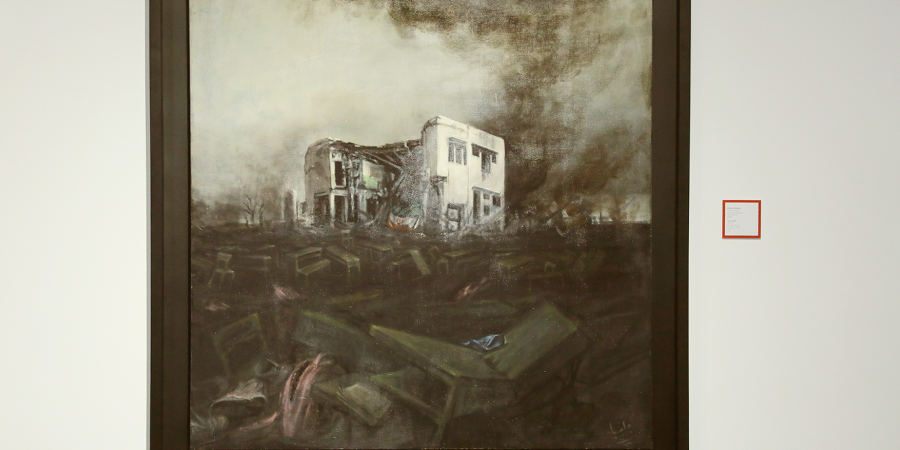
These days, the streets of Iran carry a particular pulse in the early morning and midday hours. Children and teenagers pass through the city — some on foot, some seated behind their fathers on motorcycles, some in school vans. Amid this bustle and movement, in the heart of Tehran, a school has opened its doors. But everything about it is unlike any other school. It has opened upon canvases — in memory of a school in southern Iran, in the city of Minab, bombed by the Terrorist US Military.
A company of Iran's most distinguished painters, working across a range of styles, have rendered the crime of the American military in its assault on the Shajareh Tayebeh School in Minab, an assault in which nearly 170 children and their teachers were martyred, and have brought their works together in a single exhibition.
The first painting told of an empty grave. A grave for a small boy who tasted the flavor of American democracy and freedom more deeply than any of his friends. Investigations revealed that Makan Nasiri stood at the closest distance to the impact site of the American Tomahawk missile — and some seven months after that bombardment, nothing remained of his body or his clothing except a single shoe. That same shoe became the subject of a painting by Behzad Shishegaran.
Now Makan's family have nothing of their seven-year-old son, who would have entered the second grade this year, but a memory lodged in their hearts and a burned shoe in their hands. And for the people of the world, they bear a resounding message: America's slogans of freedom and democracy find ironic translations in languages other than English — bomb, destruction, murder.
The next painting is the account of a survivor of war. Usually it is boys and men who stood on the front lines who recount the memory of their fallen comrades. This time, it is Maryam, a young child of Minab, who tells of her classmates.
Maryam lifts a painting of an angel, standing in for dozens of innocent angels of the Shajareh Tayebeh School in Minab, and her eyes search for justice — and for an answer to a question Palestinian children have posed to the people of the world for years: For what sin did you send all my friends to the cemetery?
The backdrop of this painting is an image of the Minab cemetery — a place that, in a single day, embraced the bodies of tens of children and, in the opening days of the war, laid bare before the world the true nature of American aggression.
Another canvas upon the wall stands for the survivors of this horrific event. Two girls who no longer have a school to study in. Two girls without faces — representing all the victims of the terrorism and warmongering of the US and the Zionist regime.
We Iranians regard our history and our Revolution as a continuation of the movement of the Prophet of Islam and the epic of Ashura. It is only natural that, in our minds, this tragedy should find meaning alongside religious and spiritual concepts, and become a solace for wounded hearts. Martyrdom is an end that every Muslim longs for, and the martyrdom of children, however unjust, will not be the end of their lives and their existence.
The Shajareh Tayebeh School in Minab was struck mere minutes after the bombing of the residence of the martyred Leader of the Islamic Revolution. The children of Minab were the first companions of the martyred Leader in that caravan of martyrs. Hossein Einibakhsh has made this the subject of his painting — a painting in which a martyred mother speaks with her God, and her martyred daughter, hand in hand with the father of the Ummah, departs from this world.
Undoubtedly, were it not for faith in martyrdom and in God's mercy, such a calamity would have sufficed to bring a nation to its knees. But a people who do not confine life to the span of this world will never be defeated on any battlefield.
Abdolhamid Ghadirian has depicted this very truth in his painting. There, the innocent children dragged through soil and blood go, in another world, into the embrace of the martyred daughter of Prophet Muhammad (pbut)— where they shall remain forever in peace and divine blessing.
The miniature style has long been employed in the history of Iranian painting to express heavenly and sublime concepts — and Mostafa Goodarzi, in this work, has carried the martyred children into the heavens in the arms of their teachers, to portray the height of their innocence and purity.
And perhaps the most prominent symbol linking the Minab tragedy to Ashura is the innocence of the children. Ashura was the day on which the grandson of the Prophet of Islam and his children were martyred in the most brutal manner by the usurpers of power. They stood guilty of nothing except this — that they would not bow before a usurping and corrupt ruler. Mohammad Ali Naderi, in his canvas titled Noon of the Tenth Day, depicts the children of Minab in the embrace of the survivors of Ashura and repeats the same message: their only offense was that they refused to surrender. The title of this painting is drawn from the lunar Hijri dates of two events. Ashura is the name of the tenth day of the year 61 AH — and the bombing of the Shajareh Tayebeh School in Minab occurred on the tenth day of Ramadan, 1447 AH.
Mahyar Charmchi, in his canvas, has succeeded in capturing the depth of the shock and sorrow of this event. A painting that, by placing childhood dolls and toys side by side, drives the viewer into reflection — and, with its title, pins them in place: This time, the missiles were not made of paper.
The Minab school also opened on the first day of Mehr, but in place of students, it was these Iranian painters and artists who filled its classrooms. Art is an endeavor to narrate the unspoken — and what occurred at the Shajareh Tayebeh School in Minab will demand narration for years to come. A narration of resistance, of injustice, and of love.
"Now that the gates of a new academic year are opening before a vast multitude of students, scholars, and wayfarers in pursuit of knowledge and wisdom and they begin a new chapter of learning and insight with hope in divine success, it’s fitting that we once again honor the memory of the students martyred in the recent Imposed War in sympathy with the grieving mothers and fathers. This year, the memorable days marking the start of the academic year renew the grief of separation from our departed children for us. In schools and universities, the absence of some students, professors, and teachers will be felt. And this sorrow will guide our minds toward the true nature of the conflict between good and evil, and the war between Truth and Falsehood.”[1]
[1] Imam Sayyid Mojtaba Khamenei's message on the beginning of the new academic year, Sept. 22, 2026

